
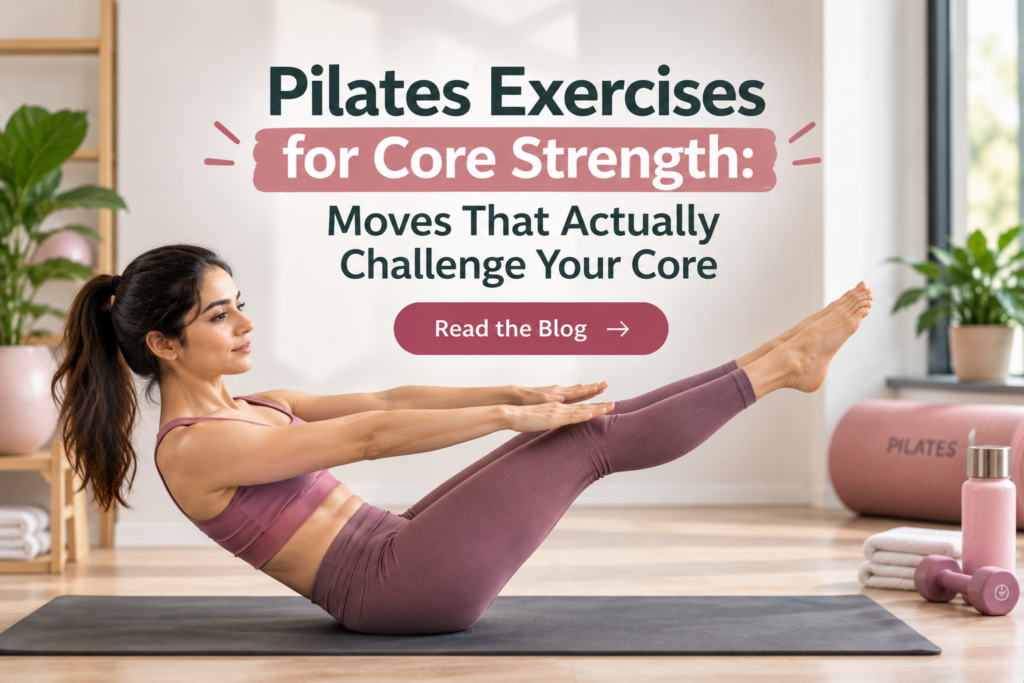
Pilates Exercises for Core Strength: Moves That Actually Challenge Your Core
Ananya had been doing 100 crunches a day for six months before she walked into our studio in Vasant Vihar. “My abs should be steel by now,” she said, half-joking, half-frustrated. Her back still hurt after long work hours, and she still couldn’t hold a plank for more than twenty seconds.
Within her first two sessions of proper Pilates exercises, she understood why. She had been training her surface muscles for months while her deep core — the muscles that actually protect the spine and hold posture — had barely been switched on. Six weeks later, the back pain was gone, her plank hit ninety seconds, and she could finally feel her core working during ordinary things like lifting her bag or climbing stairs.
This is a story we hear on repeat at The Pilates Studio Delhi NCR. So let’s talk about what real core training looks like, and which Pilates exercises for core strength actually deliver results — not just a burn.
Why Crunches Alone Don't Build a Strong Core
Most people think “core” means abs, and “abs” means crunches. But your core is a full system — deep abdominals, obliques, lower back, and pelvic floor working together. Endless crunches:
- Target only the surface muscles (rectus abdominis)
- Put strain on the neck and lower back
- Ignore the deep stabilizing muscles that support your spine
- Rarely translate into better posture or real-world strength
This is exactly why Pilates exercises work differently. Every movement is built around your center, called the “powerhouse” in Pilates language, so the deep core is engaged in almost everything you do.
Top Pilates Exercises for Core Strength
Here are the moves our trainers use most often to genuinely challenge the core, not just tire it out:
- The Hundred: A classic mat Pilates opener that fires up deep abdominals through controlled breathing and pulsing arm movements.
- Plank with Shoulder Taps: Builds core stability and challenges balance at the same time.
- Roll-Up: Strengthens the abdominals through slow, controlled spinal movement — much harder than it looks.
- Leg Circles: Trains the lower core and hip stability while keeping the spine still.
- Teaser: An advanced favourite that demands full core control from start to finish.
- Bird Dog: Builds core and back strength together, ideal for people recovering from back pain.
- Reformer Footwork and Roll-Downs: On the reformer, resistance adds a whole new layer of core engagement that mat work alone can’t replicate.
How Often Should You Train Your Core?
- Beginners: 2-3 sessions a week focusing on control, not speed
- Intermediate: 3-4 sessions mixing mat and reformer work
- Advanced: Add Teaser variations and reformer resistance work for progressive core strengthening exercises
Common Mistakes People Make With Core strength Workouts
- Rushing through reps instead of controlling each movement
- Holding the breath instead of using breath to engage the core
- Only training the front of the core and ignoring the back and obliques
- Skipping warm-ups, which limits how well the deep core activates
Why Train With Certified Pilates Instructors ?
Founded by Namrata Purohit, India’s youngest certified Stott Pilates instructor, The Pilates Studio Delhi NCR has spent years refining Pilates exercises for core strength that are safe, effective, and suited to real bodies — not just Instagram routines. Our certified trainers correct alignment in real time and build a progression that matches your body, whether you’re recovering from a back injury or training for performance.
See our Pilates training methodology for how sessions are structured for every fitness level.
Where to Find Us
We currently run studios in Chattarpur, Vasant Vihar, Defence Colony, and Gurgaon, with a growing presence across Delhi NCR. Each studio is equipped with reformers, the Cadillac, stability chairs, and ladder barrels, so your core training isn’t limited to mat work alone.
FAQs
Most people notice better engagement within 2-3 sessions, and visible strength within 4-6 weeks of consistent practice.
Mat Pilates is a great foundation, but reformer sessions add resistance that challenges the core further.
Yes, every move can be modified based on your current strength and any injuries.
Yes — a stronger deep core takes pressure off the lower back, which is why many clients start Pilates for this reason.
Pilates trains the entire core system with control and breath, rather than isolating one muscle through repetition.
Final Thoughts
Ananya didn’t need more crunches — she needed the right kind of core training. That’s really what Pilates exercises for core strength are about: fewer, smarter movements that reach the muscles doing the real work.
If you’re ready to build genuine core strength, book a trial session at The Pilates Studio in Vasant Vihar, Defence Colony, Chattarpur or Gurgaon, or explore our membership options online.
Ready to feel your core actually working? Book your trial class at The Pilates Studio Delhi NCR today, or check our reviews and find us on Google — take the first step toward real, lasting strength.