
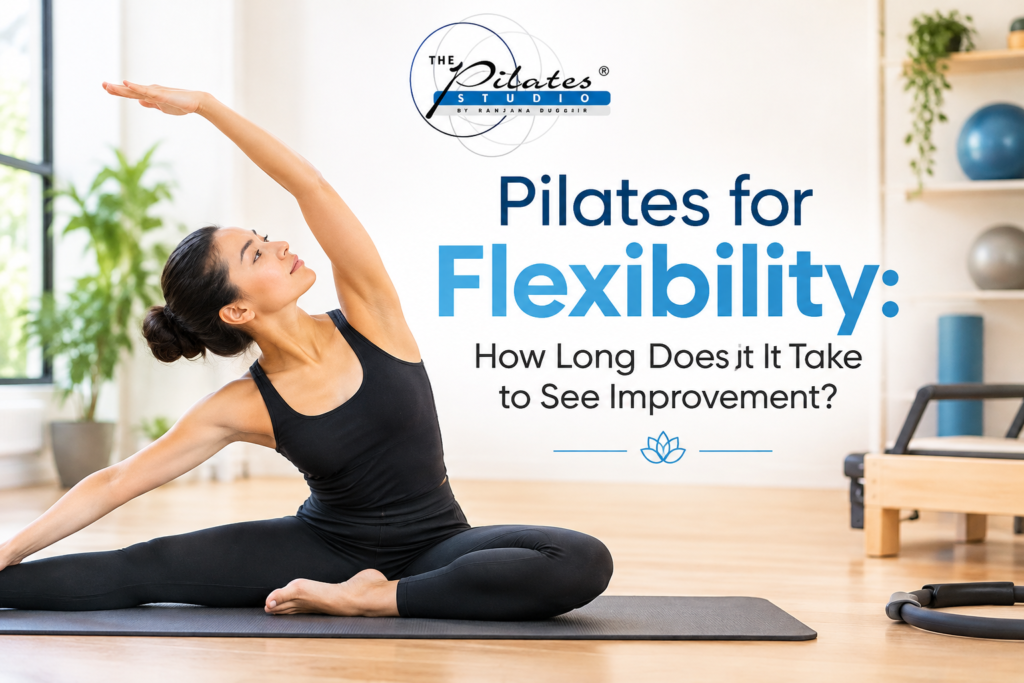
Pilates for Flexibility: How Long Does It Take to See Improvement?
Quick answer: Yes, Pilates for flexibility works. Most people feel looser in 2 to 4 weeks and see a clear change in 6 to 12 weeks, with 2 to 3 classes a week.
Ask ten people why they want to start Pilates, and at least four will say, “I just want to feel less stiff.” If that sounds like you, you are in the right place. At The Pilates Studio by Namrata Purohit, we help people across Delhi build flexibility in a safe, steady way.
Here is what to expect, and how soon.
Does Pilates Improve Flexibility?
Yes. Pilates for flexibility is slow, controlled and kind to your joints. Instead of pulling hard on a tight muscle, you stretch it while it is working. That teaches your body to relax into a longer range. Three reasons it works:
- It loosens your spine, hips and shoulders together
- It stretches and strengthens at the same time
- It uses slow breathing to switch off muscle tension
Pilates for Flexibility vs Simple Stretching
Stretching helps, but it does only half the job. Pilates for flexibility does the other half. Here is the difference in simple words:
- Muscle work: stretching is mostly passive, while Pilates is active and controlled
- Strength: stretching builds none, while Pilates builds core and hip strength
- Lasting result: stretching fades quickly, while Pilates holds for longer
- Joint safety: it is easy to overstretch alone, while Pilates is guided and gradual
Neither is wrong. But Pilates helps your new flexibility stay.
How Long Does Pilates Take to Improve Flexibility?
Every body is different, but with two to three classes a week, this is a fair guide:
- Weeks 1 to 2: your body feels more awake and less stiff after class
- Weeks 3 to 4: bending, sitting and reaching feel easier
- Weeks 6 to 8: a visible change, like reaching lower in a forward bend
- Weeks 10 to 12: the new range feels natural and stays with you
Your own pace depends on how long you have been stiff, how often you come, your age, and your sleep and stress. So treat Pilates for flexibility as a habit, not a race.
3 Myths About Pilates for Flexibility
- Myth: “I am too stiff to start.” Fact: stiff people gain the most, and trainers adjust every move to your level
- Myth: “I will see results in a week.” Fact: small changes show in weeks, bigger ones in months
- Myth: “It is only for dancers.” Fact: Pilates suits all ages and all fitness levels
So, does Pilates improve flexibility even if you feel very stiff today? Yes. The next story shows how it can look in real life.
Your First Month: A Week-by-Week Story
Let us follow a first-timer, a stiff desk worker who has not stretched in years. This is a typical picture, not a real client.
- Week 1: Everything feels new and the body is a little sore, but it also feels lighter
- Week 2: Breath and movement start to match, and standing up from the chair gets easier
- Week 3: Putting on socks and shoes is easier, and the hips feel less tight
- Week 4: Hands reach closer to the toes, and the best part is that they want to come back
Nothing dramatic happened in one day. They simply kept showing up. That is Pilates for improving flexibility in real life.
The gains also show up outside the studio. Bending to tie a shoe, sitting through Delhi traffic, or playing with your kids all start to feel lighter.
Pilates for Improving Flexibility: Moves by Body Area
Your trainer will choose moves for you. These are common ones, so you know what to expect:
- Spine: spine stretch forward and roll-down
- Hamstrings: the saw, which twists and stretches your legs together
- Hips: leg circles to free up the joints
- Sides and ribs: mermaid side stretch
Please learn these with a trainer first, so your form stays safe. Both mat and reformer classes work well for Pilates for flexibility. The reformer’s springs support you inside a stretch, so you can go deeper without strain.
Pilates Classes in Delhi for Flexibility: Find Your Studio
Our founder, Namrata Purohit, opened the first studio in Defence Colony in 2018. Today, our Pilates training is available at four studios:
- Vasant Vihar, Delhi
- Defence Colony, Delhi
- Chhatarpur, Delhi
- DLF Phase IV, Gurgaon
Every studio offers a posture check, small classes, certified trainers, and group or private sessions, from Monday to Saturday, 7 am to 9 pm. Find all addresses on our Reach Us page, or pick a plan in our booking and membership options.
Do's and Don'ts for Faster Results
- Do come two to three times a week
- Do breathe slowly through every stretch
- Do add a short walk every day
- Don’t force a stretch or bounce
- Don’t skip classes and expect quick change
Want extra strength alongside Pilates for flexibility? Our EMS training at Defence Colony is a good add-on.
FAQs on Pilates for Flexibility
Most people feel looser in 2 to 4 weeks and see a clear change in 6 to 12 weeks, if they attend two to three classes a week.
Two to three times a week works well. Regular classes matter more than long ones.
Usually yes, but tell your trainer first. If you have sharp or long-standing pain, please check with your doctor.
We have studios in Vasant Vihar, Defence Colony and Chhatarpur, plus one in Gurgaon. Call us or visit the Reach Us page to book.
Yes. Beginners often improve the fastest. You do not need to be flexible to begin.